Location
Leshan City, Sichuan Province. 170km south of Chengdu, approx. 2.5 hours by car.
The world's largest stone Buddha — carved from a mountain, watching over three rivers
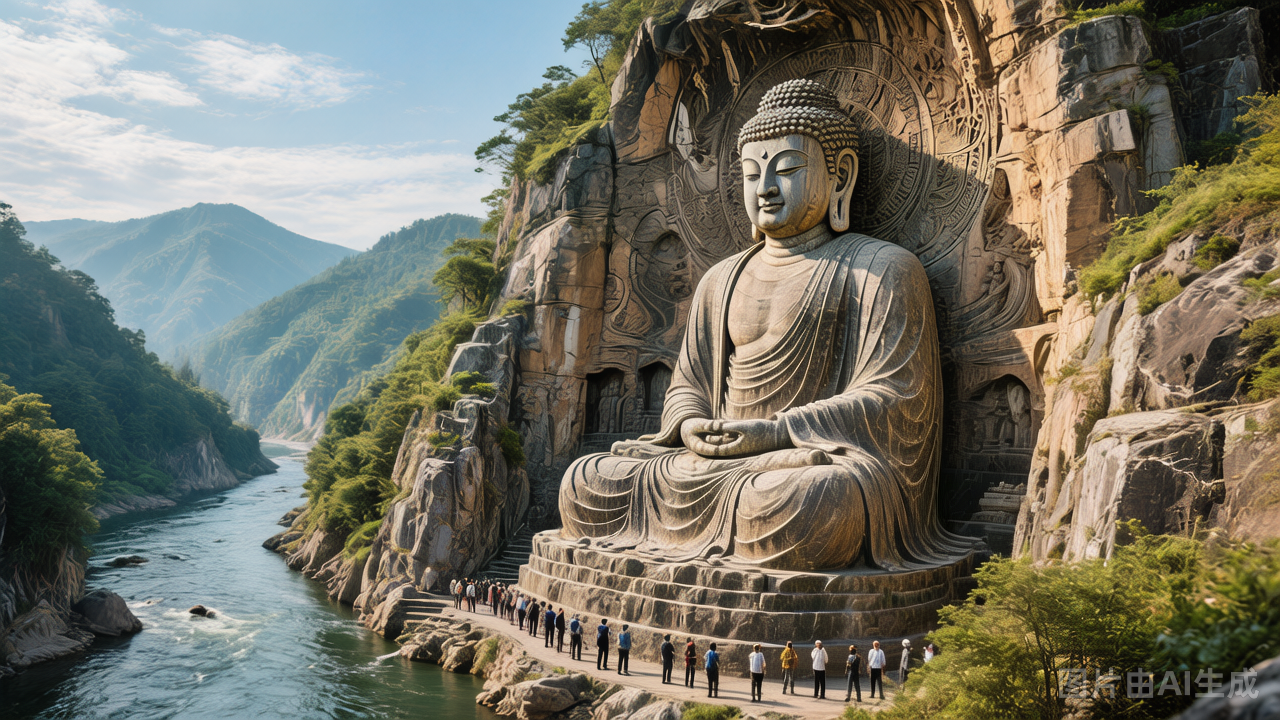
Construction began in 713 CE under the supervision of the monk Haitong, who believed a Buddha carved into the cliff face would calm the turbulent waters where the Min, Dadu and Qingyi rivers converge — a deadly crossing point for boatmen. It took 90 years and three generations of craftsmen to complete.
Today the Leshan Giant Buddha (乐山大佛) stands 71 metres tall — taller than the Statue of Liberty. Its toes alone are large enough for twenty people to stand on. It has sat in this posture of meditation, hands on knees, watching the river, for over 1,200 years.
Taller than the Statue of Liberty (93m with pedestal). The head alone is 14.7 metres — roughly the height of a 5-storey building.
Each ear is 7 metres long. The nose is 5.6 metres. Each eye is 3.3 metres wide. The face is the size of a tennis court.
The instep of each foot is large enough to seat 20 people. In the feet are carved hundreds of small Buddha figures visible up close.
Three generations of craftsmen worked the cliff from 713 to 803 CE. The monk Haitong famously gouged out his own eyes to prove devotion when funds were threatened.
The Buddhist monk Haitong began the project to calm the dangerous river confluence that had killed countless boatmen. When local officials attempted to extort construction funds, he is said to have gouged out his own eyes and offered them on a platter — a act of devotion that shamed the officials into withdrawing.
Haitong died before the project was finished. It was completed by two Tang Dynasty governors — Wei Gao and Zhang Chou — over nearly a century of work. The excavated stone that was removed was thrown into the river, actually reshaping the dangerous currents below.
Hidden within the Buddha's hair, body and robe is an elaborate drainage system of channels and gutters designed to prevent erosion. This ancient engineering — invisible to casual visitors — has preserved the statue through 1,200 years of Sichuan rain and river flood.
The Leshan Giant Buddha was inscribed on the UNESCO World Heritage List jointly with Mount Emei in 1996. Together they represent one of the most significant Buddhist cultural sites in the world — and one of the most visited, drawing millions of pilgrims and tourists annually.
The choice of how you approach changes the experience fundamentally. Inner China's programme includes all three, in sequence.
Leshan City, Sichuan Province. 170km south of Chengdu, approx. 2.5 hours by car.
Inner China provides private transfer. Frequently combined with an Emei Mountain overnight as a 2-day programme.
Site entrance: ¥90 RMB. Boat tour: ¥70. All included in Inner China programmes.
7:30 AM – 7:00 PM daily. Inner China guests enter at 7:30 before crowds arrive. Summer: open until 8:30 PM.
The boat view at morning light (8:00–9:00 AM) and the river-level cliff path offer the best shots. The top-down view from Lingyu Temple is uniquely dramatic.
Lingyu Temple (凌云寺) and Wuyou Temple (乌尤寺) are both worth visiting. Emei Mountain is 30 minutes away and naturally combined.
The Leshan Giant Buddha is included in Inner China's 15-day programme and available as a day trip add-on. Pair it with Emei Mountain for an unforgettable two-day Buddhist pilgrimage through Sichuan.
Enquire Now Emei Mountain →