Location
Guanghan City, Deyang, Sichuan Province. 50km north of Chengdu, approx. 60 minutes by car.
Where 3,000-year-old bronze masks stare back at you across an impossible gap
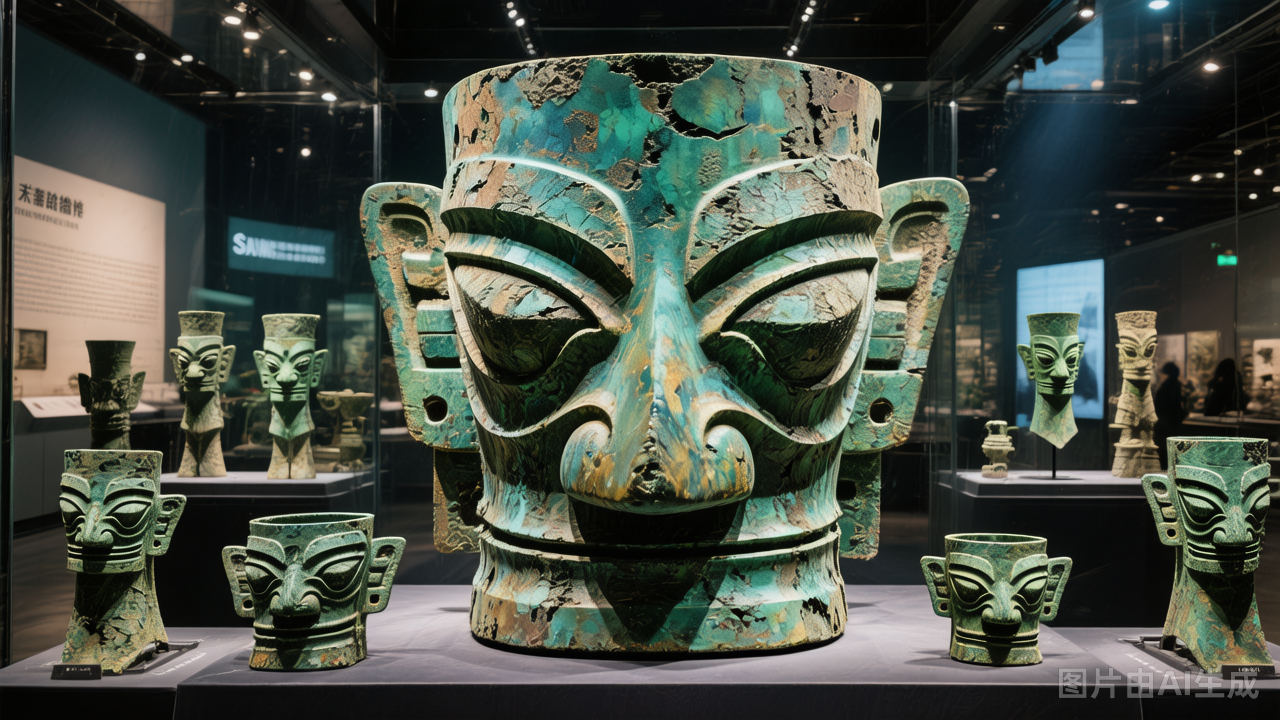
In 1986, workers digging an irrigation ditch outside Guanghan, Sichuan, struck a cache of bronze artifacts unlike anything previously found in China. Two sacrificial pits contained thousands of objects — bronze masks with alien-like protruding eyes, a 3.95-metre standing bronze figure, gold-foil covered staffs, jade blades and elephant tusks — all ritually burned and buried 3,000 years ago.
The Sanxingdui culture had no writing, left no known descendants, and vanished completely. Nothing in the Central Plains tradition explains these objects. They suggest a sophisticated, aesthetically extraordinary civilization that existed entirely outside the mainstream narrative of Chinese cultural origins.
These are not ordinary museum pieces. Each object asks questions that remain unanswered. Your guide will explain why each is significant — and why nobody agrees on what they mean.
Wide, flat faces with grossly protruding eyes (sometimes extending 16cm), enormous ears, and a permanent expression that reads as simultaneously serene and alien. No parallels exist anywhere in Bronze Age China. Some theorize they represent a deity; others, a king; others, something for which we have no category.
A 3.95-metre standing human figure wearing a crown — the tallest Bronze Age cast figure in the world. Its outstretched hands originally held something, now lost. It stands in the museum with a calm authority that makes visitors instinctively lower their voices.
A reconstructed bronze tree nearly 4 metres tall, with branches bearing fruit and birds, and a dragon descending the trunk. It represents Fusang — the mythological tree at the edge of the world where the sun rises. One of the most extraordinary bronze castings in human history.
A gold-foil-wrapped wooden staff 142cm long, covered in hammered images of fish, birds, and human heads. The symbolism is completely undeciphered. It is the most technically accomplished gold work of the period in Asia — and nobody is sure what it was for.
Unearthed from the newly excavated Pit 5 in 2021, this near-complete gold mask is the most intact gold ceremonial object from ancient Sichuan. The excavation was live-streamed and watched by 50 million people. It is still being studied.
Over 60 elephant tusks were found layered in the original pits and in the new pits opened since 2019. Where they came from — and why they were placed here — remains debated. In a temperate Sichuan, the presence of this many elephant tusks suggests trade networks of extraordinary reach.
Part of what makes Sanxingdui so compelling for thoughtful visitors is not what it reveals — but what it refuses to reveal. Your Inner China guide will walk you through the ongoing debates.
The Sanxingdui culture produced objects of extraordinary technical and artistic complexity — but left no writing whatsoever. Every other advanced Bronze Age civilization in the world left writing. Why not this one? Was it intentional? Was writing unnecessary? Or does the writing exist somewhere not yet found?
The Sanxingdui civilization simply vanished around 1000 BCE — the artifacts were burned, ritually buried, and the city abandoned. There is no gradual decline, no conquest narrative, no obvious successor culture. The Jinsha culture that followed it nearby shared some aesthetics but was clearly different. What happened?
The most distinctive feature of Sanxingdui masks — the dramatically protruding, cylinder-like eyes — has never been satisfactorily explained. Ancient texts mention a legendary Shu king named Cancong (蚕丛) whose eyes "protruded vertically." Were these masks depicting a real trait of a real ruler, or a symbolic representation of supernatural vision?
In 2019, four additional sacrificial pits were discovered adjacent to the original two. Excavated with modern technology and live-streamed globally, they contained thousands more artifacts — including objects not yet fully studied. The new finds include a rare gold mask and a bronze figure wearing a garment decorated with what appear to be serpents.
Inner China provides a full-day guided visit to Sanxingdui, with expert commentary from a local cultural historian. This is a very different experience from self-guided visiting.
Guanghan City, Deyang, Sichuan Province. 50km north of Chengdu, approx. 60 minutes by car.
Inner China provides private transfer. Alternatively, express bus from Chengdu North Bus Station (北门汽车站): 45 minutes, ¥20.
¥99 RMB general admission. Timed entry tickets must be booked in advance on the official WeChat mini-program. Included in Inner China programmes.
8:00 AM – 6:00 PM (last entry 5:00 PM). Closed Mondays (except national holidays). Allow a minimum of 4 hours.
Photography permitted throughout. No flash. The bronze mask hall offers dramatic lighting for portrait shots. Tripods not permitted.
The museum's English signage is adequate but thin on context. Inner China's cultural historian guide transforms the experience from "interesting museum" to "encounter with the genuinely strange."
Sanxingdui is included in Inner China's 15-day Deep Immersion programme and available as an add-on day trip. It changes how you think about everything else you will see in Sichuan — and about civilization itself.
Enquire Now I Ching Programme →